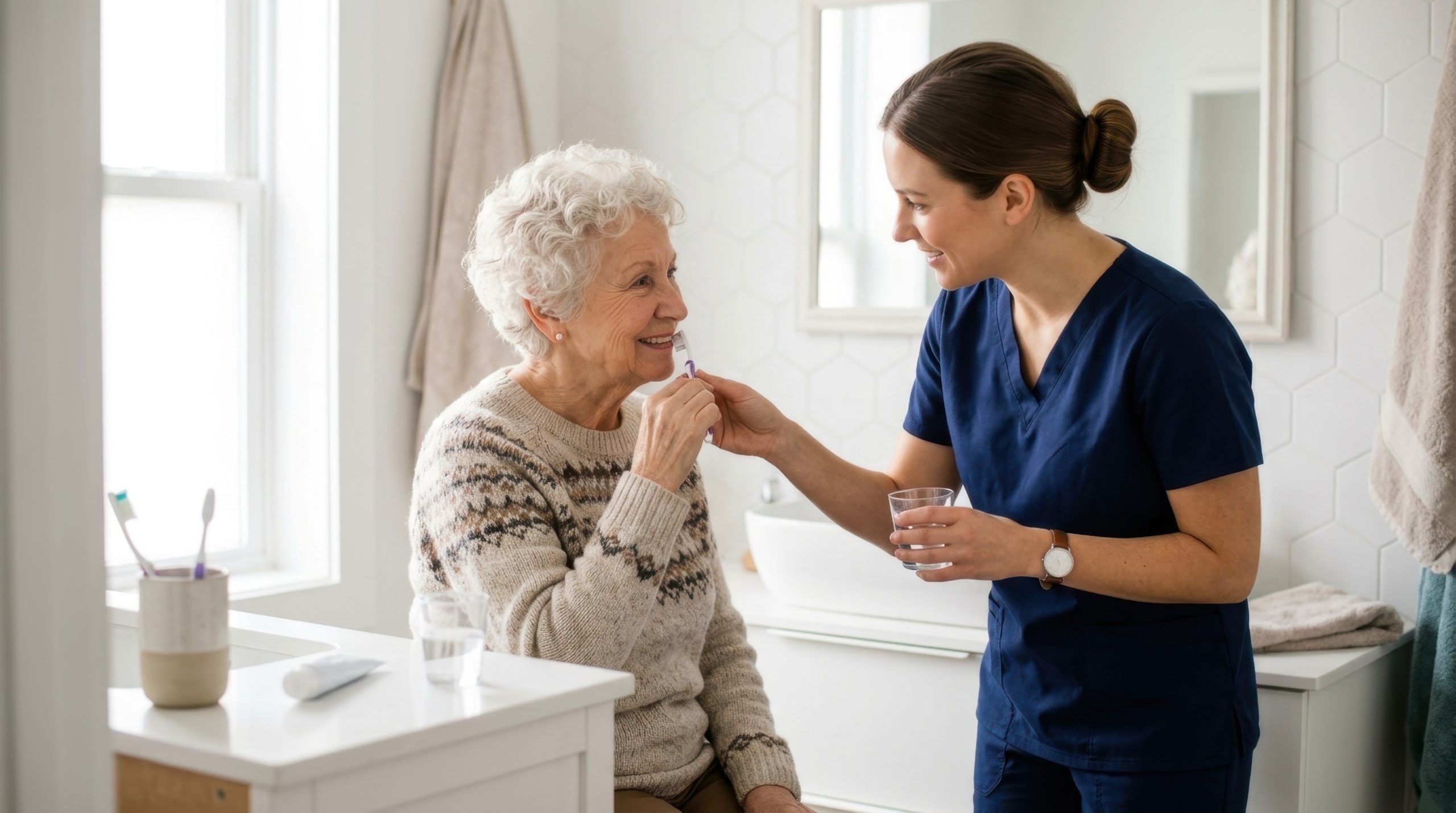
Navigating nonverbal cues in dementia care means learning to read body language, facial expressions, and behavioral changes as a form of communication, since verbal ability often declines as the condition progresses. Caregivers who develop this skill can better anticipate needs, reduce distress, and provide more compassionate care.
Dementia progressively limits a person’s ability to express him or herself through words, making nonverbal communication one of the most important tools in a caregiver’s toolkit. Understanding these unspoken signals can mean the difference between a calm moment and a distressing one.
What Types of Nonverbal Cues Should Caregivers Watch For?
Nonverbal cues fall into several categories, each carrying different information about your senior loved one’s emotional and physical state:
- Facial expressions – Furrowed brows, grimacing, or a blank stare may signal pain, confusion, or discomfort.
- Body language – Crossed arms, pacing, or rocking can indicate anxiety or agitation.
- Eye contact – Sustained eye contact may signal a desire to connect. Avoidance may signal withdrawal or distress.
- Gestures – Pointing, reaching, or pushing away are often attempts to communicate a need or preference.
- Vocalizations – Moaning, sighing, or repeated sounds—even without clear words—carry emotional meaning.
Living with dementia can make it difficult for seniors to manage everyday tasks on their own. Certain age-related conditions can make it more challenging for seniors to age in place safely and comfortably, but 24-hour home care experts are available around the clock to help Naples seniors manage their health. Whether your loved one is living with dementia or recovering from a stroke, you can trust the professional caregivers from Assisting Hands Home Care to enhance his or her quality of life. At Assisting Hands Home Care, we take measures to help seniors prevent illness and injury by assisting with exercise and mobility, preparing nutritious meals, helping with bathing and other personal hygiene tasks, and much more.
How Can Caregivers Accurately Interpret What These Cues Mean?
Context is everything. A grimace during mealtime likely signals something different than one during personal care. To interpret cues accurately:
- Track patterns over time by keeping a simple log of behaviors and the circumstances surrounding them.
- Consider physical triggers first—hunger, pain, a full bladder, or fatigue are common causes of behavioral changes.
- Compare current behavior to your loved one’s baseline. Shifts from the norm are often the most telling signals.
- Consult with family members who knew your loved one before the diagnosis, as personal history adds important context.
What Are the Most Effective Ways to Respond to Nonverbal Distress Signals?
Once a cue is identified, the response matters as much as the recognition:
- Stay calm – A composed tone and relaxed posture can de-escalate distress quickly, since people with dementia often mirror the emotional energy around them.
- Use gentle touch – A soft hand on the shoulder or holding hands can provide reassurance when words fall short.
- Minimize stimulation – Reduce background noise, bright lights, or crowded environments that may be amplifying discomfort.
- Offer choices nonverbally – Show two objects (e.g., a glass of water and a snack) and observe the reaction rather than asking open-ended questions.
Trained caregivers who have experience in communicating with seniors with dementia can be a fantastic resource for family members. If your senior loved one has been diagnosed with a serious condition and needs help with tasks like meal prep, transportation, medication reminders, bathing, and grooming, reach out to Assisting Hands Home Care, a leading provider of Naples at-home care. We also offer comprehensive care for seniors with dementia, Alzheimer’s, and Parkinson’s.
How Can Caregivers Use Their Own Nonverbal Communication More Effectively?
Caregivers communicate nonverbally too, and people with dementia remain highly attuned to these signals even as verbal comprehension fades:
- Approach slowly and from the front to avoid startling your loved one.
- Position yourself at eye level to convey respect and safety.
- Use open, relaxed body language rather than crossed arms or rushed movements.
- Smile genuinely. Emotional authenticity is often felt even when words aren’t understood.
- Maintain consistent routines and physical environments, as familiarity itself is a form of nonverbal reassurance.
How Does Nonverbal Communication Change as Dementia Progresses?
As dementia advances, nonverbal cues become the primary—and eventually the sole—mode of communication:
- Early stages – Your loved one may still use words but increasingly rely on gestures and expressions to fill in gaps.
- Middle stages – Behavioral cues become more prominent. Repetitive movements or emotional outbursts often signal unmet needs.
- Late stages – Responses may be limited to subtle changes in breathing, muscle tension, or eye movement, requiring caregivers to develop a finely tuned sense of observation.
Adapting to each stage requires ongoing attention and a willingness to relearn your loved one’s evolving communication style.
Even when families have the best intentions, caring for a senior loved one with dementia can be challenging. Fortunately, Assisting Hands Home Care is here to help. We are a leading provider of dementia care Naples families can trust. You can take advantage of our flexible and customizable care plans, and our caregivers always stay up to date on the latest developments in senior care. To hire a professionally trained caregiver for your parent, give us a call today.
Frequently Asked Questions
Why do people with dementia stop using words to communicate?
+
Dementia damages the brain regions responsible for language over time, making it increasingly difficult to find, form, or express words, while the ability to feel and respond emotionally often remains intact longer.
Can someone with dementia still understand what I’m saying even if he or she can’t respond verbally?
+
Comprehension often persists longer than the ability to speak, so continuing to speak in a calm, clear, and kind tone remains important even when verbal responses are limited.
How can I tell the difference between pain and emotional distress through nonverbal cues?
+
Pain often presents as localized guarding, wincing, or reluctance to move a specific body part, while emotional distress tends to involve broader agitation, withdrawal, or repeated vocalizations without a clear physical trigger.
Are there tools or resources that help caregivers track nonverbal behavior patterns?
+
Simple caregiver journals, behavior tracking apps, and structured observation tools like the Pain Assessment in Advanced Dementia (PAINAD) scale can help you identify patterns and enhance your loved one’s care over time.
How do I stay patient when nonverbal cues are difficult to read?
+
Taking brief pauses, practicing deep breathing, and reminding yourself that unclear cues reflect the disease—not the person—can help caregivers maintain patience during challenging moments.